South Carolina history in 60 dated events, from about 13,000 years ago (Human groups were living in what became South Carolina by about 13,000 years ago, the time) to January 12, 2017. Every row links the National Park Service, state archive, agency or encyclopedia page it was read from.
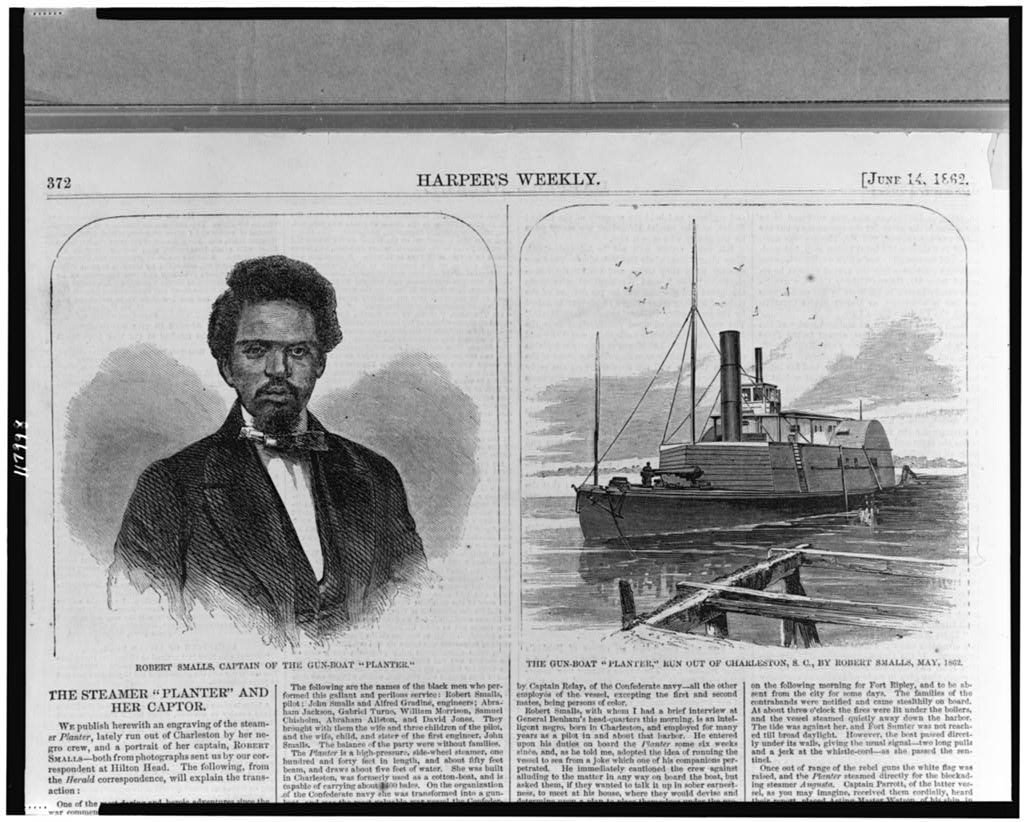
Header photo: Harper’s Weekly, June 14, 1862: Robert Smalls and the Planter, which he took out of Charleston in May 1862. Credit: Library of Congress, Prints & Photographs Division, LC-USZ62-117998.
- 60dated events
- 10eras
- about 13,000 years agoearliest date on the list
- 56source pages cited
- First peoples
- Spanish and French era
- Colonial era
- Revolution
- Early statehood
- Civil War
- Reconstruction
- New South and industry
- Civil rights
- Modern era
Download this data: CSV · JSON · 60 events · free to reuse under CC BY 4.0 with a link to It’s South Carolina. All open data: catalog.json.
First peoples
| When | What happened | Where | Source |
|---|---|---|---|
| about 13,000 years ago | Human groups were living in what became South Carolina by about 13,000 years ago, the time frame widely accepted by archaeologists (scant evidence suggests possibly 18,000 years ago). | South Carolina | South Carolina Encyclopedia: Prehistoric South Carolina |
| five thousand to three thousand years ago | Late Archaic peoples built fifteen shell ring complexes along the outer coastal plain and made early clay pottery. | Coastal plain | South Carolina Encyclopedia: Prehistoric South Carolina |
Spanish and French era
| When | What happened | Where | Source |
|---|---|---|---|
| September 1526 | Lucas Vázquez de Ayllón founded San Miguel de Gualdape, the first Spanish town in the present-day United States; scholars place it at various sites on the South Carolina and Georgia coast. | South Carolina/Georgia coast (site unknown) | South Carolina Encyclopedia: San Miguel de Gualdape |
| April to May of 1540 | Hernando de Soto’s expedition crossed present-day South Carolina in search of the chiefdom of Cofitachiqui. | Interior South Carolina | South Carolina Encyclopedia: De Soto’s exploration of South Carolina |
| 1562 | Jean Ribault’s men built Charlesfort, the first French settlement in the present-day United States; archaeologists located its site on Parris Island in the 1980s. | Parris Island (Beaufort) | South Carolina Encyclopedia: Charlesfort |
| April 1566 | Pedro Menéndez de Avilés founded Santa Elena on present-day Parris Island; it served as capital of Spanish La Florida for much of its first ten years and lasted until 1587. | Parris Island (Beaufort) | South Carolina Encyclopedia: Santa Elena |
Colonial era
| When | What happened | Where | Source |
|---|---|---|---|
| 1663 | King Charles II granted the land that became North and South Carolina to eight English noblemen, the Lords Proprietors. | Carolina (grant) | South Carolina Encyclopedia: Lords Proprietors of Carolina |
| April 1670 | Settlers from England and the Caribbean founded Charles Towne at Albemarle Point on the west bank of the Ashley River, the first permanent European settlement in Carolina. | Charleston (Albemarle Point) | South Carolina Encyclopedia: Charleston |
| by 1680 | Charles Towne was moved to Oyster Point at the tip of the peninsula, the site of today’s downtown Charleston. | Charleston | South Carolina Encyclopedia: Charleston |
| January 17, 1711 | Beaufort was chartered; it is the second-oldest town in South Carolina. | Beaufort | South Carolina Encyclopedia: Beaufort |
| 1715-1718 | The Yamassee War, which also involved Cherokees, Creeks and Choctaws, spread from the Savannah River to Charleston. | Lowcountry (Pocotaligo Town and beyond) | South Carolina Encyclopedia: Yamassee War |
| December 1719 | The Revolution of 1719, an almost bloodless coup by colonists, ended proprietary rule in South Carolina. | Charleston | South Carolina Encyclopedia: Revolution of 1719 |
| 1729 | Elisha Screven founded Georgetown, the third-oldest town in South Carolina. | Georgetown | South Carolina Encyclopedia: Georgetown |
| 1735 | About 220 German-Swiss immigrants settled along the North Edisto River, beginning the town of Orangeburg. | Orangeburg | South Carolina Encyclopedia: Orangeburg |
| September 9, 1739 | The Stono Rebellion, South Carolina’s largest and bloodiest slave insurrection, began on a branch of the Stono River as enslaved people tried to reach freedom in Spanish Florida. | Stono River, St. Paul’s Parish (Charleston) | South Carolina Encyclopedia: Stono Rebellion |
| 1759-1761 | The Cherokee War, partly a southeastern phase of the French and Indian War, was fought on the colony’s western frontier. | Upstate frontier | South Carolina Encyclopedia: Cherokee War (1759-1761) |
Revolution
| When | What happened | Where | Source |
|---|---|---|---|
| June 28, 1776 | Patriots in an unfinished palmetto-log fort on Sullivan’s Island (later Fort Moultrie) defeated a British attack, the first major patriot victory of the war. | Sullivan’s Island (Charleston) | South Carolina Encyclopedia: Sullivan’s Island, Battle of |
| 1777 | After a full-scale patriot assault on their towns, the Cherokees ceded most of their South Carolina land. | Upstate (Cherokee Lower Towns) | South Carolina Encyclopedia: Cherokees |
| May 12, 1780 | Charleston surrendered to the British after a siege, beginning major British operations in the South. | Charleston | South Carolina Encyclopedia: Charleston, Siege of (April-May 1780) |
| August 16, 1780 | The Battle of Camden was one of the worst defeats suffered by the Continental army. | Camden (Kershaw) | South Carolina Encyclopedia: Camden, Battle of |
| August 19, 1780 | At Musgrove’s Mill, 200 Patriot militia defeated a larger Loyalist and British Provincial force. | Musgrove Mill (near Clinton) (Laurens) | Battle of Musgrove Mill State Historic Site (SC State Parks) |
| October 7, 1780 | Patriot militia defeated British Major Patrick Ferguson’s Loyalist force at Kings Mountain, the first major patriot victory after the British took Charleston. | Kings Mountain (York) | South Carolina Encyclopedia: Kings Mountain, Battle of |
| January 17, 1781 | Daniel Morgan’s army turned both flanks of Banastre Tarleton’s British army at Cowpens in a classic double envelopment. | Cowpens (Cherokee) | South Carolina parks list (NPS) – Cowpens National Battlefield |
| 1781 | Nathanael Greene besieged the British-held Star Fort at Ninety Six for twenty-eight days. | Ninety Six (Greenwood) | South Carolina Encyclopedia: Ninety-Six, Battles of |
| September 8, 1781 | Greene’s army fought the British at Eutaw Springs. | Eutaw Springs (Orangeburg) | South Carolina Encyclopedia: Eutaw Springs, Battle of |
| December 14, 1782 | The British evacuated Charleston, ending more than two years of occupation; the departing fleet carried 3,700 loyal whites and 5,000 enslaved people. | Charleston | South Carolina Encyclopedia: Charleston |
Early statehood
| When | What happened | Where | Source |
|---|---|---|---|
| 1786 | The legislature created Columbia, named for Christopher Columbus, as a planned capital near the geographic center of the state. | Columbia (Richland) | South Carolina Encyclopedia: Columbia |
| May 1788 | South Carolina ratified the U.S. Constitution; the final vote in the Charleston convention was 149 to 73. | Charleston | South Carolina Encyclopedia: Ratification of the U.S. Constitution |
| December 19, 1801 | South Carolina College, today the University of South Carolina, was chartered. | Columbia (Richland) | South Carolina Encyclopedia: University of South Carolina |
| 1822 | Charleston authorities broke up the planned uprising led by Denmark Vesey, a free Black man; tribunals ordered 35 men hanged. | Charleston | South Carolina Encyclopedia: Vesey, Denmark |
| 1832-1833 | Nullifiers called a state convention that nullified the federal tariffs, a crisis eased by the compromise tariff of 1833. | Columbia (Richland) | South Carolina Encyclopedia: Nullification |
| October 3, 1833 | The South Carolina Canal and Rail Road reached Hamburg; at 136 miles it was then the longest railroad under single management in the world. | Charleston to Hamburg | South Carolina Encyclopedia: South Carolina Railroad |
| December 1845 | The General Assembly chartered the Graniteville Company, one of the South’s earliest and most successful textile mills. | Graniteville (Aiken) | South Carolina Encyclopedia: Graniteville Company |
| December 1851 | Construction began on the South Carolina State House in Columbia; the building was not completed for decades. | Columbia (Richland) | South Carolina Encyclopedia: State House |
Civil War
| When | What happened | Where | Source |
|---|---|---|---|
| December 20, 1860 | The 169 delegates of the South Carolina convention in Charleston voted unanimously to secede from the Union. | Charleston | South Carolina Encyclopedia: Secession |
| April 12, 1861 | Confederate forces fired on the U.S. garrison at Fort Sumter, opening the Civil War. | Fort Sumter, Charleston Harbor | Fort Sumter and Fort Moultrie National Historical Park (NPS) |
| November 7, 1861 | U.S. forces won the Battle of Port Royal, establishing a Union base on the South Carolina coast. | Port Royal Sound (Beaufort) | South Carolina Encyclopedia: Port Royal, Battle of |
| May 13, 1862 | Robert Smalls led the enslaved crew of the steamer Planter past Charleston harbor’s defenses and surrendered the vessel to the U.S. blockading fleet. | Charleston Harbor | South Carolina Encyclopedia: Smalls, Robert |
| 1862 | Northern missionaries Laura Towne and Ellen Murray established Penn School on St. Helena Island, one of the earliest schools for freed people. | St. Helena Island (Beaufort) | South Carolina Encyclopedia: Penn Center |
| January 1, 1863 | Ceremonies at Camp Saxton in Port Royal celebrated the Emancipation Proclamation, starting South Carolina’s Emancipation Day tradition. | Camp Saxton, Port Royal (Beaufort) | Reconstruction Era National Historical Park FAQ (NPS) |
| July 18, 1863 | The Fifty-fourth Massachusetts, a regiment of Black soldiers, spearheaded the assault on Battery Wagner on Morris Island. | Morris Island (Charleston) | South Carolina Encyclopedia: Battery Wagner |
| February 17, 1864 | The Confederate submarine H. L. Hunley attacked and sank the USS Housatonic about four miles off Sullivan’s Island. | Off Sullivan’s Island (Charleston) | South Carolina Encyclopedia: H. L. Hunley |
| February 17-18, 1865 | Sherman’s Union army captured Columbia and one-third of the city burned; who burned Columbia remains controversial. | Columbia (Richland) | South Carolina Encyclopedia: Columbia, Burning of |
Reconstruction
| When | What happened | Where | Source |
|---|---|---|---|
| 1868 | Of 124 delegates to South Carolina’s 1868 constitutional convention, 73 were Black or of mixed ancestry. | Charleston | South Carolina Encyclopedia: Reconstruction |
| December 1870 | Joseph Hayne Rainey of Georgetown took his seat in Congress, the first Black man to serve in the U.S. House of Representatives. | Georgetown | South Carolina Encyclopedia: Rainey, Joseph Hayne |
| July 8, 1876 | The Hamburg Massacre grew out of white hostility to a Black state militia company in the town of Hamburg; Reconstruction in South Carolina ended in 1877. | Hamburg (Aiken) | South Carolina Encyclopedia: Hamburg Massacre |
New South and industry
| When | What happened | Where | Source |
|---|---|---|---|
| August 31, 1886 | The giant Charleston earthquake struck; three later shocks of magnitude 5.0-5.9 recorded in the state were its aftershocks. | Charleston | South Carolina Encyclopedia: Earthquakes |
| September 1934 | During the General Textile Strike, six strikers were killed at the Chiquola mill in Honea Path. | Honea Path (Anderson) | South Carolina Encyclopedia: General Textile Strike |
Civil rights
| When | What happened | Where | Source |
|---|---|---|---|
| 1947 | In Elmore v. Rice, federal judge J. Waties Waring ruled against South Carolina’s whites-only Democratic primary after George Elmore was denied a primary ballot in Richland County. | Columbia (Richland) | South Carolina Encyclopedia: Elmore v. Rice |
| 1952-1954 | Briggs v. Elliott, filed by twenty Black parents in Clarendon County, became one of the five cases decided in Brown v. Board of Education. | Summerton (Clarendon) | South Carolina Encyclopedia: Briggs v. Elliott |
| January 31, 1961 | CORE’s Thomas Gaither and nine Friendship Junior College students were arrested at McCrory’s lunch counter in Rock Hill; Gaither and eight students chose thirty days’ hard labor instead of $100 fines. | Rock Hill (York) | South Carolina Encyclopedia: Rock Hill Movement |
| January 1963 | Harvey Gantt became the first African American student at Clemson College. | Clemson (Pickens) | South Carolina Encyclopedia: Gantt, Harvey |
| February 8, 1968 | Three students, Samuel Hammond, Delano Middleton and Henry Smith, were killed by gunfire at South Carolina State during protests over a segregated bowling alley (the Orangeburg Massacre). | Orangeburg | South Carolina Encyclopedia: Orangeburg Massacre |
| 1969 | More than four hundred African American hospital workers, mostly women, struck the Medical College Hospital and Charleston County Hospital. | Charleston | South Carolina Encyclopedia: Charleston hospital workers’ strike |
Modern era
| When | What happened | Where | Source |
|---|---|---|---|
| September 22, 1989 | Hurricane Hugo made landfall near Sullivan’s Island with a twenty-foot storm surge in Bulls Bay. | Sullivan’s Island / Bulls Bay (Charleston) | South Carolina Encyclopedia: Hurricanes |
| 1993 | A land-claims settlement restored federal recognition to the Catawba Indian Nation. | Catawba Reservation (York) | South Carolina Encyclopedia: Catawbas |
| July 1, 2000 | The Confederate battle flag was lowered from the State House dome and moved to the grounds beside the Confederate monument. | Columbia (Richland) | South Carolina Encyclopedia: Confederate flag controversy |
| October 12, 2006 | Congress designated the Gullah Geechee Cultural Heritage Corridor, running from Pender County, N.C., to St. Johns County, Fla. | Coastal South Carolina | Gullah Geechee Cultural Heritage Corridor (NPS) |
| June 17, 2015 | A gunman killed nine African American members of a Bible study group at Mother Emanuel AME Church in a racist attack. | Charleston | South Carolina: Mother Emanuel AME Church (NPS) |
| January 12, 2017 | A presidential proclamation created Reconstruction Era National Monument in Beaufort County; it became a National Historical Park on March 12, 2019. | Beaufort, Port Royal, St. Helena Island | Reconstruction Era NHP – Management (NPS) |
What we could not verify
- Battle counts differ: the state tourism site says more than 200 Revolutionary War battles and skirmishes were fought in South Carolina; SC250 says more than in any other colony but gives no number.
- The South Carolina Encyclopedia dates the burning of Columbia to February 17-18, 1865 in one entry and to the night of February 17 in another. The year Hampton Plantation’s house was built has not been settled.
We re-check these when the source pages change. Spot something we missed? Use the corrections page.
Frequently asked questions
When did South Carolina ratify the U.S. Constitution?
South Carolina ratified the Constitution in May 1788. Ratification was never in doubt: at the convention in Charleston, Federalists beat the Anti-Federalists by more than two to one, 149 to 73. The U.S. Senate dates ratification to May 23, 1788 (source: South Carolina Encyclopedia: Ratification of the U.S. Constitution).
What were the first European settlements in South Carolina?
Spain and France came first. Spain founded San Miguel de Gualdape in 1526, France built Charlesfort in 1562, and Spain founded Santa Elena on present-day Parris Island in April 1566. Santa Elena served as capital of Spanish La Florida for much of its first ten years and lasted until 1587 (source: South Carolina Encyclopedia: Santa Elena).
When did South Carolina secede from the Union?
South Carolina seceded on December 20, 1860, when the 169 delegates of the state convention meeting in Charleston voted unanimously to leave the Union. Less than four months later, on April 12, 1861, Confederate guns fired on Fort Sumter (source: South Carolina Encyclopedia: Secession).
Last checked October 20, 2026 by the It’s South Carolina editors against each operator’s, agency’s or organizer’s own page.
Sources
- South Carolina Encyclopedia: Prehistoric South Carolina
- South Carolina Encyclopedia: San Miguel de Gualdape
- South Carolina Encyclopedia: De Soto’s exploration of South Carolina
- South Carolina Encyclopedia: Charlesfort
- South Carolina Encyclopedia: Santa Elena
- South Carolina Encyclopedia: Lords Proprietors of Carolina
- South Carolina Encyclopedia: Charleston
- South Carolina Encyclopedia: Beaufort
- South Carolina Encyclopedia: Yamassee War
- South Carolina Encyclopedia: Revolution of 1719
- South Carolina Encyclopedia: Georgetown
- South Carolina Encyclopedia: Orangeburg
- South Carolina Encyclopedia: Stono Rebellion
- South Carolina Encyclopedia: Cherokee War (1759-1761)
- South Carolina Encyclopedia: Sullivan’s Island, Battle of
- South Carolina Encyclopedia: Cherokees
- South Carolina Encyclopedia: Charleston, Siege of (April-May 1780)
- South Carolina Encyclopedia: Camden, Battle of
- Battle of Musgrove Mill State Historic Site (SC State Parks)
- South Carolina Encyclopedia: Kings Mountain, Battle of
- South Carolina parks list (NPS) – Cowpens National Battlefield
- South Carolina Encyclopedia: Ninety-Six, Battles of
- South Carolina Encyclopedia: Eutaw Springs, Battle of
- South Carolina Encyclopedia: Columbia
- South Carolina Encyclopedia: Ratification of the U.S. Constitution
- South Carolina Encyclopedia: University of South Carolina
- South Carolina Encyclopedia: Vesey, Denmark
- South Carolina Encyclopedia: Nullification
- South Carolina Encyclopedia: South Carolina Railroad
- South Carolina Encyclopedia: Graniteville Company
- South Carolina Encyclopedia: State House
- South Carolina Encyclopedia: Secession
- South Carolina Encyclopedia: Port Royal, Battle of
- South Carolina Encyclopedia: Smalls, Robert
- South Carolina Encyclopedia: Penn Center
- Reconstruction Era National Historical Park FAQ (NPS)
- South Carolina Encyclopedia: Battery Wagner
- South Carolina Encyclopedia: H. L. Hunley
- South Carolina Encyclopedia: Columbia, Burning of
- South Carolina Encyclopedia: Reconstruction
- South Carolina Encyclopedia: Rainey, Joseph Hayne
- South Carolina Encyclopedia: Hamburg Massacre
- South Carolina Encyclopedia: Earthquakes
- South Carolina Encyclopedia: General Textile Strike
- South Carolina Encyclopedia: Elmore v. Rice
- South Carolina Encyclopedia: Briggs v. Elliott
- South Carolina Encyclopedia: Rock Hill Movement
- South Carolina Encyclopedia: Gantt, Harvey
- South Carolina Encyclopedia: Orangeburg Massacre
- South Carolina Encyclopedia: Charleston hospital workers’ strike
- South Carolina Encyclopedia: Hurricanes
- South Carolina Encyclopedia: Catawbas
- South Carolina Encyclopedia: Confederate flag controversy
- Gullah Geechee Cultural Heritage Corridor (NPS)
- South Carolina: Mother Emanuel AME Church (NPS)
- Reconstruction Era NHP – Management (NPS)
Cite this page: It's South Carolina, “South Carolina History Timeline: 60 Dated Events With Sources”, itssouthcarolina.com/history/timeline/ (updated ). By the It's South Carolina editorial team. Free to quote with attribution and a link to this page; data and tables are licensed CC BY 4.0.